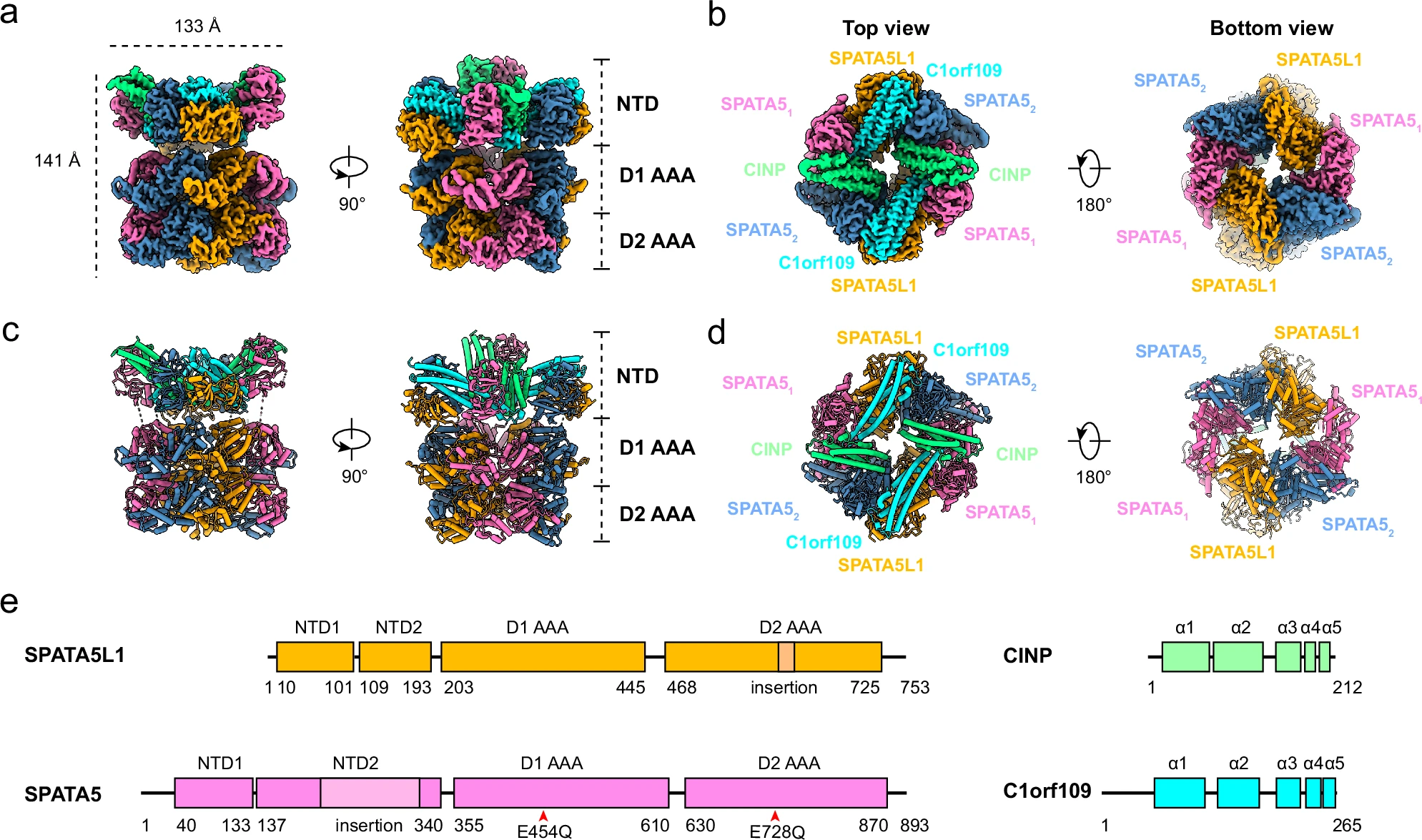
The study, led by Professor Ning Gao, was published in Nature Communications in April 2025. Using cryo-electron microscopy, the researchers were able to visualise the molecular structure of the human SPATA5 complex and investigate how it interacts with immature ribosomal particles.
What are ribosomes?
Every cell in the human body needs to manufacture proteins.
Proteins perform an enormous range of functions: they form structural components of cells, act as enzymes, transmit signals and allow cells to respond to their environment.
Ribosomes are the molecular machines that build these proteins.
But ribosomes do not simply appear fully formed. Their components have to be assembled and processed through a complex series of steps known as ribosome biogenesis.
One of the major components of a mature ribosome is the 60S large subunit. Before it can participate in protein production, immature pre-60S particles undergo a series of maturation steps inside the cell.
This is where SPATA5 comes in.
SPATA5 and the pre-60S ribosome
The Peking University researchers found that human SPATA5 forms a previously unrecognised molecular complex with three other proteins: SPATA5L1, C1orf109 and CINP.
The complex has a highly organised architecture, with two AAA+ ATPase rings and an N-terminal ring formed by parts of the four proteins.
The researchers found that this complex interacts with immature pre-60S ribosomal particles and participates in their maturation.
In other words, SPATA5 is not simply associated with ribosomes indirectly. It forms part of the molecular machinery responsible for preparing one of the major components of the ribosome for its eventual role in protein production.
Why does this matter for SPATA5-related disease?
This discovery could help explain why mutations in SPATA5 produce such a broad neurodevelopmental disorder.
The brain is particularly dependent on tightly regulated protein production, especially during early development. Developing neurons must continuously produce large quantities of proteins as they grow, migrate, form connections and establish complex networks.
If a protein involved in ribosome maturation is disrupted, the consequences could therefore extend well beyond a single cellular pathway.
This provides another possible connection between a molecular defect in SPATA5 and the developmental and neurological features observed in affected children.
It does not mean that ribosome dysfunction explains the entire SPATA5 phenotype. Rather, it adds another important piece to an increasingly complex biological picture.
The connection with SPATA5L1
The finding is particularly interesting because SPATA5 does not appear to work alone.
SPATA5L1 — the closely related gene whose mutations can also cause an overlapping neurodevelopmental disorder — is part of the same complex.
This provides a potential molecular explanation for why SPATA5 and SPATA5L1 disorders can share such similar clinical features.
The two proteins participate together in a common cellular process, alongside C1ORF109 and CINP.
This is one example of why studying SPATA5 and SPATA5L1 together may be important for understanding the broader spectrum of AFG2A-related disease.
Seeing the machinery in three dimensions
A particularly powerful aspect of this research is the technology behind it.
The researchers used cryo-electron microscopy, or cryo-EM, to determine the structure of the SPATA5 complex at molecular resolution.
Cryo-EM allows researchers to freeze biological molecules in very cold conditions and reconstruct their three-dimensional structures from thousands or millions of individual images.
This means scientists can move beyond asking whether two proteins interact and begin to see how they physically interact.
In the Peking University study, cryo-EM revealed how the SPATA5 complex is organised and how it interacts with pre-60S ribosomal particles. The researchers also identified specific molecular interactions that help the complex recognise its target.
A human-specific mechanism
The research also revealed something particularly interesting about the human system.
In yeast, a related protein called Drg1 performs a role in ribosome maturation. SPATA5 is the human homolog of Drg1.
However, the human mechanism is not simply a copy of the yeast system.
The researchers found that CINP acts as a human-specific factor helping the SPATA5 complex recognise pre-60S particles through interactions with other ribosomal components.
This suggests that the human SPATA5 machinery has evolved additional mechanisms that are not present in simpler model organisms.
That matters when studying human disease because it highlights one of the limitations of relying exclusively on animal or yeast models. Some aspects of SPATA5 biology may only become apparent when the human molecular system is studied directly.
An unexpected connection to cellular stress
The researchers also identified a potentially important regulatory mechanism involving SPATA5 itself.
A conserved cysteine residue, C672, was found to undergo oxidation to a sulfinylated state. This modification produces an inactive configuration of SPATA5 that is incompatible with ATP binding.
Because AAA+ proteins depend on ATP to perform their molecular work, this provides a potential mechanism through which cellular conditions could regulate SPATA5 activity.
The finding raises interesting questions about how SPATA5 activity may respond to the cellular environment and whether disturbances in this regulation could contribute to disease.
These are still fundamental biological questions rather than therapeutic findings, but understanding them could eventually become important for identifying ways of modifying disease mechanisms.
From mitochondria to ribosomes
The discovery is especially important when viewed alongside earlier SPATA5 research.
SPATA5 has been associated with mitochondrial dynamics and neuronal function. More recent research now places it within the machinery responsible for ribosome maturation.
At first these functions may appear unrelated.
But both mitochondria and ribosomes are fundamental to the ability of cells to maintain themselves and respond to their environment.
Mitochondria help provide the energy required by cells.
Ribosomes produce the proteins cells need to function.
SPATA5 therefore appears to participate in more than one essential aspect of cellular biology.
This may help explain why disrupting the gene can have consequences across several organ systems and why the clinical phenotype is so complex.
What this means for future research
The Peking University study does not provide a treatment for SPATA5-related disease.
Its importance is more fundamental.
Before researchers can design effective therapies, they need to understand exactly what the affected protein does, which cellular processes are disrupted and how particular mutations alter those processes.
The structural information generated by this study provides researchers with a much clearer picture of the SPATA5 complex and its interaction with ribosomes.
It also identifies specific molecular interfaces and regulatory mechanisms that could be investigated in future studies.
The authors suggest that the human-specific features identified in the complex may ultimately provide opportunities for therapeutic research.
Why fundamental research matters
For an ultra-rare disorder, fundamental research can sometimes seem far removed from treatment.
A cryo-EM structure of a protein complex does not immediately translate into a medicine.
But discoveries at this level provide the biological foundation on which therapeutic research depends.
Understanding the molecular machinery affected by SPATA5 allows researchers to ask increasingly precise questions:
Which mutations disrupt the complex?
Do different mutations interfere with ribosome maturation to different degrees?
Which cells are most vulnerable to these disruptions?
Can the cellular consequences be corrected?
And could a future treatment restore or compensate for the function that is lost?
These questions cannot be answered without first understanding the underlying biology.
For SPATA5 and SPATA5L1, that understanding is still developing. The discovery of the SPATA5 ribosome-maturation complex represents another important step in that process.