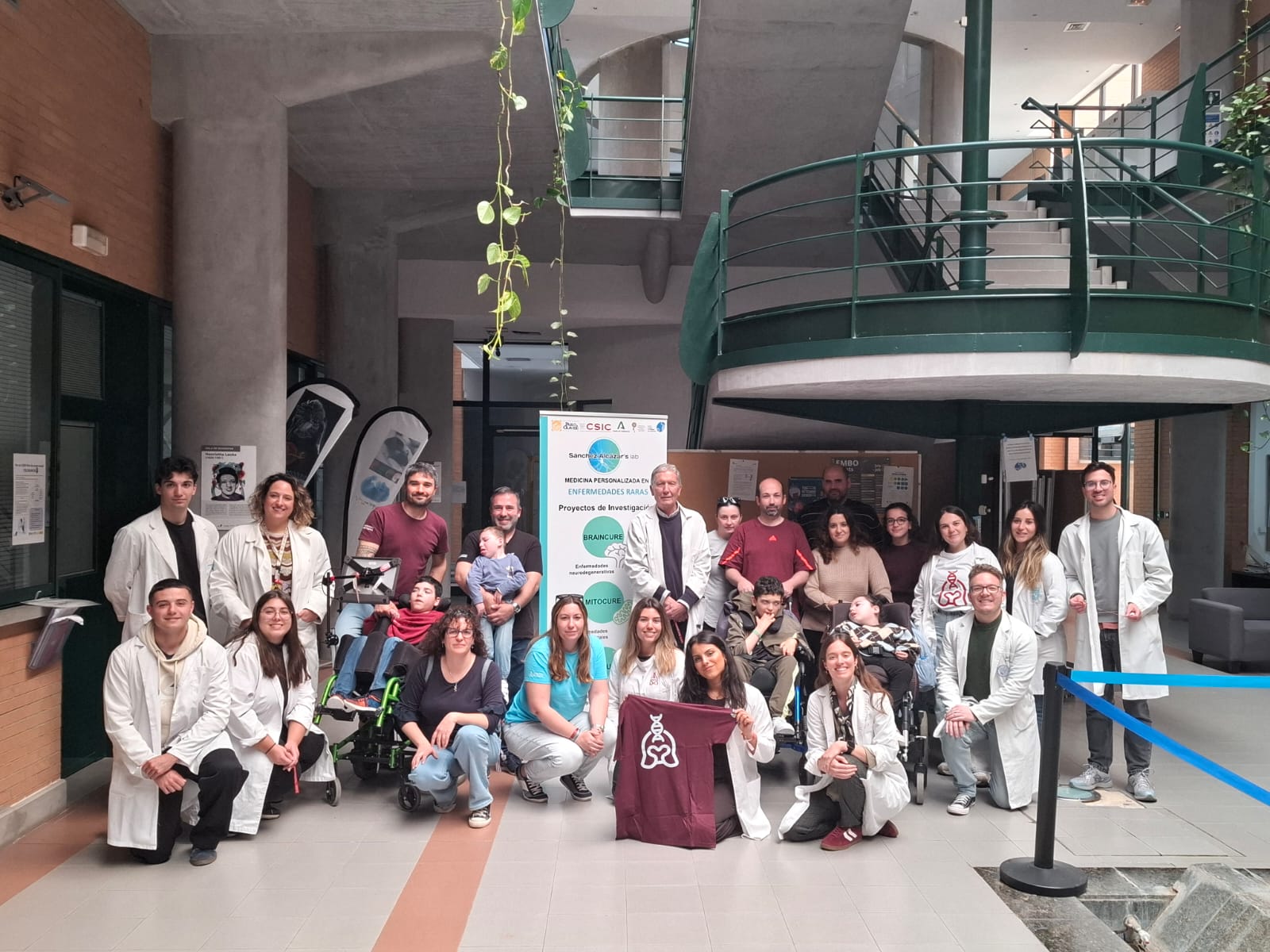
The project brings together ASPATA5, the Spanish association representing families affected by SPATA5 mutations, with researchers at the Universidad Pablo de Olavide (UPO) and the Centro Andaluz de Biología del Desarrollo (CABD). The scientific work is led by researcher José Antonio Sánchez Alcázar and forms part of the MITOCURE platform, which develops personalised approaches to mitochondrial disorders.
From genetic diagnosis to personalised treatment
SPATA5-related disorders are caused by pathogenic variants in the SPATA5 gene and can result in a complex combination of neurological and developmental features, including epilepsy, hearing loss, intellectual disability and motor difficulties. Research has increasingly pointed towards abnormalities in mitochondrial function as an important part of the disease biology.
The Seville project takes this mitochondrial connection as a starting point.
Rather than testing a single treatment across all patients, the researchers are investigating the specific cellular consequences of individual SPATA5 and SPATA5L1 mutations.
To do this, the team works with biological material obtained from affected patients, including skin fibroblasts. These cells can be studied in the laboratory to determine how a particular mutation affects cellular function. The researchers can then investigate whether those abnormalities can be improved using potential therapeutic compounds.
The project also involves generating neurons through cellular reprogramming, allowing researchers to study the effects of SPATA5 mutations in cells that are particularly relevant to the neurological features of the disorder.
This approach is at the heart of MITOCURE, a personalised medicine platform developed to investigate mitochondrial dysfunction using cells derived from individual patients. The platform is already being applied to mutations associated with mitochondrial disorders.
The objective is not simply to ask whether a treatment works in general, but whether a particular intervention can correct or improve the specific cellular dysfunction caused by a patient’s mutation. This could ultimately help identify therapeutic strategies tailored to different genetic variants.
What treatments are being investigated?
The current research is particularly focused on compounds with the potential to improve mitochondrial function, including antioxidants and mitochondrial-enhancing compounds.
The researchers first study the cellular abnormalities produced by the mutation and then test candidate compounds directly on patient-derived cells. If a compound improves the relevant cellular functions in the laboratory, this can provide evidence for further investigation and, potentially, future clinical research.
This is an important distinction: the project is currently preclinical research. It is not yet a clinical trial and cannot establish that any particular treatment is effective in people with SPATA5-related disorders.
Nevertheless, patient-derived cellular models offer an important opportunity to move from simply describing the consequences of a rare genetic mutation towards identifying potential therapeutic strategies.
A project driven by families
The project also illustrates an increasingly important role played by rare-disease families in advancing research into conditions that affect very small patient populations.
ASPATA5 was established by families affected by SPATA5 mutations in Spain, with the aim of raising awareness, supporting affected families and promoting research into the condition. Since its creation, the association has worked to raise funds specifically to make research possible.
The Seville project is being financed entirely by affected families and funds raised through their fundraising efforts. The estimated cost is approximately €50,000 per year, with the research initially planned for between two and four years.
This means that families are effectively creating and sustaining a research programme for a condition for which dedicated scientific resources remain extremely limited.
It is a striking example of how, in ultra-rare diseases, families can become catalysts for scientific research: identifying researchers, building institutional relationships and raising the funding necessary to generate knowledge that would otherwise be unlikely to emerge.
Why this research matters
For families living with SPATA5-related disorders, the absence of established disease-modifying treatments can make the future uncertain. Research such as this seeks to address one of the most fundamental questions facing the community:
Can understanding the precise biological consequences of SPATA5 and SPATA5L1 mutations help identify treatments that actually target those consequences?
There is no guarantee that the compounds being investigated will ultimately become treatments. However, establishing patient-derived cellular models, understanding the mechanisms affected by different mutations and identifying compounds that can improve those cellular abnormalities are important steps towards therapeutic development.
The Seville project therefore represents more than a single research study. It contributes to building the scientific infrastructure and biological understanding needed to develop future therapies for SPATA5-related disorders.
For ultra-rare conditions, where the number of affected individuals is small and conventional commercial incentives for research may be limited, initiatives such as this demonstrate what can be achieved when families, patient organisations and academic researchers work together towards a common scientific goal.